

How To Clean Up Brown Hair Algae
Brown algae tainting your tank? Looking for information how y'all can get rid of information technology?
In this guide, you'll be walked through how to place brown freshwater and marine algae, the root causes, and how to remove and prevent information technology from coming dorsum.
What is Brown Algae?
Brown algae (grade Phaeophyceae) isn't really a algae at all. It's made up of little unmarried-celled organisms chosen diatoms.
There are several different species of brown algae (diatoms), some freshwater species and some marine algae.
They're i of those little organisms that's near always present in any aquatic surround.
Usually, a few of them hang out in the background and yous don't fifty-fifty notice they're there. But, sometimes conditions are correct for them to pop upward in huge numbers, called a diatom flower.
Even though they're not really a species of brown alage, you can even so just call them brown algae, lots of people practice. In this article I'll employ both terms interchangeably.
Diatoms get lumped in with true algae because they are very similar. They both need light to grow, they eat organic wastes like nitrates (NO3-) and phosphates (PO4) out of the water cavalcade.
And they can both be a real hurting in the barrel if they get out of control in your tank.
What makes brown algae unlike from true algae is that it also needs silica (SiO2) to live, simply algae does not. Silica is a natural chemical compound made up of silicon and oxygen. Diatoms use information technology to build tough outer cell walls for themselves.
Chocolate-brown algae is very common in new tanks. Normally, a few weeks afterward a tank starts to cycle, diatoms start to appear in the tank.
Before the nitrogen wheel gets up and running, the nutrient balance in the tank tin can be out of whack. The diatoms pop up to consume these excess nutrients.
They usually go away on their own later on a few weeks, but sometimes it can accept several months.
There are steps you tin take to become rid of brownish algae more quickly. I'll discuss those subsequently.
But sometimes diatom blooms crop up in established tanks. This is usually a sign that there is some kind of imbalance in the tank that needs to be addressed.
Tin can Brown Algae Harm Your Fish?
Don't worry. Brown algae won't hurt your fish at all.
It but looks yucky.
How to Identify Brownish Algae
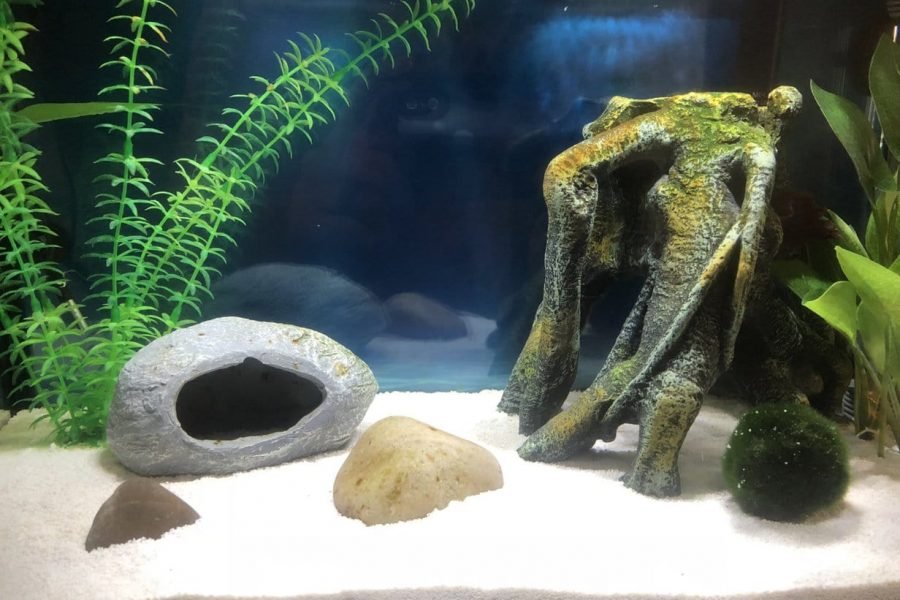
The easiest way to identify brown algae in a freshwater tank is simply by the color. It's…well…brown. It's usually a rusty brown or mustard color. Information technology grows in a sparse layer over the glass, substrate and simply nigh whatsoever other surface in the tank.
If you lot rub a picayune piece off your glass with your fingertip, information technology should experience a little bit gritty.
In marine tanks, at that place is something called cyanobacteria that can await similar to brown algae.
The all-time way to tell diatoms from cyanobacteria is how hands it comes off a surface.
With diatoms, yous take to rub or wipe them off. And only the part you are touching will come off. It doesn't peel off in sheets.
Cyanobacteria is different. You tin can grab a piece and skin it upwards in big sheets or clumps.
Pro Tip: Only peel blue-green alga as an experiment/diagnostic tool. Peeling it up might exist tempting, just this will only break off pieces that volition colonize other parts of your tank!
Even but strong h2o current will usually blow cyanobacteria off.
Basically, if it comes off really, really easily, it's cyanobacteria and non diatoms.Also, cyanobacteria will have lots of fiddling bubbles clinging to it all the time. Diatoms practise not.
Find the Root Cause
The well-nigh efficient and fastest fashion to remove brown algae, is to starting time by identify information technology's root crusade.
Permit's go through what you should be checking.
Silicates
Having excess silicates in the tank is just way too tempting for diatoms.
It's like wearing meat pants in a tiger cage, information technology's non gonna become well for you.
When you add together new sand substrate, especially play, blasting or pool sand, it creates a huge spike in silicates. Eventually, the diatoms should eat up the silicate so die off, but this could take months.
Some salt mixes for marine tanks incorporate silicates. Check the label and consider changing brands if your salt mix contains silica.
High Nitrates
Nitrates are a natural byproduct of the nitrogen cycle. Equally fish waste material breaks downwards, information technology puts off ammonia (NH3 ).
The beneficial bacteria in your filters and substrate process the ammonia and create nitrite (NO2 -one). Then the nitrite gets turned into nitrate.
Over fourth dimension, nitrate tin can start to build up in your water if it'southward not removed by h2o changes.
Brown algae loves to eat nitrate (truthful algaes love it, too). It's similar steak dinner with a side of steroids for this stuff.
Test for nitrate levels in your tank. Ideally you want to maintain less than 20 ppm. At all times.
Pro Tip: Keeping nitrate levels low in your tank is the single most important matter you tin exercise to maintain a good for you aquarium. Loftier nitrates assistance fuel algae outbreaks and can stress fish, making them more prone to affliction. Always do weekly water changes.
Make sure to also examination your tap water. Some water supplies choice up nitrate from things like agricultural runoff or backyard chemicals. It doesn't harm humans when they potable information technology, but it tin can brand things complicated for a fish tank.
High Phosphates
Every aquarium has phosphates. In fact, every living thing depends on phosphate equally an essential nutrient, even yous.
So phosphate is literally a part of life and there'south no getting away from them completely.
But, if phosphate levels get too high in your tank, they can assist fuel both diatom and true algae blooms.
In an aquarium, uneaten food, fish waste, dead plant material, all of it puts off phosphate as information technology breaks downwards.
You should test both your tap and tank h2o to see only how much phosphate is floating around.
Poor Lighting
Brown algae thrives in dim lighting that would starve other algae species.
In a tank with vivid lights, light-green algae out-compete brown algae for nutrients in the water column.
6 Means you tin can Remove Brown Algae
Once you've identified your crusade, it's time to look at your options to remove information technology from your tank.
Let's become through some battle tested techniques.
1. Perform Water Changes
Keep the buckets handy, you're gonna demand them.
Doing frequent water changes is one of the best ways to help remove brown algae.
When you practise change out h2o, information technology removes the nitrates and phosphates that the dark-brown algae eats.
Brand sure to really become downwards in the substrate with a gravel vacuum. Fish waste falls down to the tank floor and sinks into the gravel.
All that waste constantly puts off nitrate and phosphate. Getting information technology out of the tank helps to starve out the diatoms.
2. Removing Brown Algae from Tank Drinking glass
For this, I actually like to use a scrubbing pad. Brand sure it doesn't take any added cleansers or soaps. Simply the plain inexpensive kind works the best.
Equipment:
– Scrubbing pads
– Small-scale bucket of water
Steps:
i. Take the scrubbing pad in your mitt and put it against the glass only above the substrate.
two. Keep steady pressure level on the scrubby as yous pull your manus directly up until yous get above the water line.
3. Take the scrubby out of the tank and squeeze it out in the bucket.
4. Repeat this until you take cleaned all the glass in the aquarium.
I know this technique can seem a bit of a pain.
That's because information technology is.
But, doing information technology this way means you wipe off the brown algae and keep it from floating around in the tank.
If yous just move the scrubby up and down forth the glass, diatoms that you scrub off the drinking glass will get into the h2o cavalcade.
Then they'll float around and start growing somewhere else in the tank.
Wiping from bottom to top, and wringing out the scrubbing pad, removes more diatoms from the tank.
3. Removing Brown Algae from Substrate
I've split this into two parts for you: Gravel and Sand.
Removing Brown Algae from Gravel
The all-time manner to get brown algae off your gravel is with a gravel vacuum. Really button the lift tube down into the gravel.
As the gravel tumbles effectually, most of the diatoms should come off and become sucked out through the hose.
Removing Brown Algae from Sand
Non gonna lie, sand is a bit trickier. Information technology easily gets sucked upwards into the siphon.
i. Moving ridge the gravel vacuum just above the surface of the sand to get any fish waste material.
2. And then, pinch off the hose then there is very little suction.
iii. Stir upwards the sand really well with the gravel vacuum to break loose the brown algae.
iv. Pick the gravel vac upwards out of the sand, unpinch the hose and become upward as much of the cloud of algae every bit yous can.
5. Keep repeating this process until you've cleaned up all the sand.
4. Removing Brownish Algae from Fake Plants and Other Decor
It'south all-time to remove false plants and decor from the tank to become the diatoms off. That style, the ones y'all scrub off don't just attach themselves somewhere else in the tank.
You lot tin can scrub the algae off with a soft-bristled scrub brush or clean toothbrush.
Sometimes though, you need to pull out the large guns, significant bleach. Peculiarly for decor with hard to get spots or resin decorations where the pigment might come up off.
Bluntly, I notice bleaching much easier for plastic plants that have all the niggling incommunicable to make clean spots on them.
Equipment:
Buckets
Bleach (plainly bleach with no added scents or other ingredients)
Measuring cup
Tap water
Dechlorinator
Steps:
one. Mix one part bleach to 20 parts tap water.
ii. Let decor soak for 10 minutes.
three. Dump the bleach mix and rinse until you can't odor bleach anymore.
4. Fill a bucket with fresh tap water and add together 5 times the normal tank dose of dechlorinator.
5. Soak decor for 10 minutes.
5. Better Lighting
Improving the lighting in your tank can aid encourage green algae to abound. It's really easier to control the green algae.
So having greenish algae in the tank instead of brown can make things easier.
Plus, in that location aren't very many critters that will eat diatoms, especially in a freshwater tank.
Only, in that location are lots of fish and invertebrates that volition happily munch on true algae.
Add together lighting that provides a broader spectrum of light and that reaches the bottom of the tank.
Improving lighting tin can besides help alive plants thrive. The plants can then out-compete the diatoms for nutrients in the water column.
six. Eat Brownish Algae
I'm not ask yous to grub downward, rather, you tin can introduce some species into your tank that'll gobble up your brown algae.
Freshwater Species that Eat Brown Algae
Nerite Snails – these petty guys are dandy at eating upwards brown algae. They likewise cannot breed in a freshwater aquarium. So you don't take to worry that you lot'll end upwardly with hundreds of them. They'll scour any surface in the tank and won't consume up live plants.
Amano shrimp – these freshwater shrimp will swallow brown algae and only about any other kind of algae that grows in a tank. But, they really won't clean the glass in your tank.
Other Species – otoclinus catfish and bristlenose plecos may eat brown algae, only they also might not. The nerites are a safer bet.
Saltwater/Marine Species that Eat Brown Algae
Trochus snails – genus of marine snails with a conical crush. They are great at cleaning up diatoms on all tank surfaces. They're likewise a cool species because they tin can right themselves if they get flipped over, dissimilar many other snail species.
Mexican Turbo snails (Turbo fluctuosa) – turbos are also very efficient at eating diatoms off of live rock, tank walls and substrate. They are nocturnal and a larger snail that might not exist great for minor setups.
nine Ways to Prevent Brown Algae from Coming Dorsum
And so you've managed to beat the brown algae downwardly.
Only how do y'all make sure information technology doesn't come back?
1. Increase Filtration
Increasing filtration tin can really keep brown algae gone. Diatoms love to eat the organic compounds that come from uneaten food and fish waste as it breaks down.
Make sure that your filter is rated for the size of your tank. This will help process waste more than efficiently and assist keep the h2o in the tank moving.
If your current filter is not upwardly to snuff, you lot tin can ever add on a sponge filter to give you a boost or upgrade to an external canister filter. They're cheap, easy to fix and run and actually add a lot of biofiltration.
2. Keep Upwards with Your Water Changes
Keeping upwards with aquarium maintenance is so important to go on brown algae (and other pesky things) from popping dorsum up.
Changing out water gets rid of the nitrates and phosphates that dark-brown algae needs to live. Have abroad the food, and all of a sudden your tank doesn't seem so highly-seasoned to the diatoms.
Make sure to do 25%-50% h2o changes each week.
3. Increase Water Flow
Brown algae really doesn't like loftier h2o menstruum. It prefers more stagnant water. Increasing water catamenia ways that they can't anchor onto surfaces and outset to grow.
Calculation additional powerheads and making sure there are no "dead zones" in the tank can get a long way towards keeping diatoms from coming dorsum.
iv. Avert Silicates
Silicates can hitch a ride into your tank in several ways.
Some water supplies have added silicates in the tap water. Run into the "Utilize RO Water" section below for how to deal with this.
Many claim that excess silicates can come from using play sand or other silicate-based sand equally your substrate. The theory is that these substrates slowly leach silicate into your water and the diatoms happily set upwardly shop and eat it.
Another source can exist using regular table salt in your aquarium.
Some fish, similar certain African cichlids and livebearers, need at least some common salt in the water all the fourth dimension.
But, if you use regular table salt equally your source, it also has added silicates as an anti-caking agent.
Pro Tip: If you're going to add table salt to your tank, use aquarium common salt or puddle salt. These practise not have the added silicates
5. Avoid Overfeeding
Yous'll see lots of sources state that overfeeding causes a lot of problems.
That'south because it's true!
Overfeeding causes all sorts of problems, including nuisance diatoms and algaes.
Yous should merely feed your fish what they can eat in almost 30 seconds (3 minutes for fish who consume really slowly).
Here's why. Uneaten food sinks to the bottom and puts off tons of nitrate and phosphate. It's bad news and can really foul your water.
Also, even if your fish eat all the nutrient, if you lot feed them more than their bodies demand, all the extra just gets passed through as waste material.
More waste material means more nitrates and phosphates.
And the more you feed, the more you need to clean the tank.
And so don't overfeed!
6. Use a UV Sterilizer
UV sterilizers laissez passer water through a tube with a very bright UV or UVC light. The light tin impale algae, diatoms, bacteria and even some viruses that laissez passer past in the water.
The UV tin kill any floating diatoms so they don't have a chance to adhere and grow on surfaces.
Pro Tip: UV sterilizers are a not bad investment. Not only can they assistance with algae blooms, only are a slap-up style to prevent disease in your aquarium.
vii. Use Reverse Osmosis (RO) Water
Some tap water tin have loftier nitrate, phosphate and added silicate levels. And so you might want to consider investing in an RO unit to help cut downwards on impurities.
These filters push h2o through membranes that are so fine that information technology removes almost all other substances. RO water is commonly virtually 95% pure.
Pro Tip: RO units take all of the minerals out of h2o. All species of fish demand at least some calcium and magnesium to replace what their bodies utilise up. You should add minerals dorsum to RO water with things like Seachem Furnish or Weco Wonder Shells
8. Chemic Filtration
At that place are several chemical filtration options out in that location that can help remove silica, nitrate and phosphate from your tank h2o.
Fresh and Saltwater
Seachem Phosguard – Phosguard is an aluminum oxide (Al2O3) filter media that removes both silicates and phosphates.
Sale
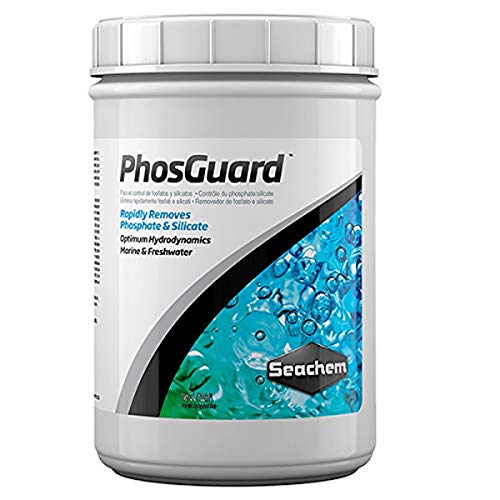
Seachem PhosGuard i Liter
Last update on 2022-03-24 / Commissions Earned / Images from Amazon Product Advertising API
Seachem Phosbond – Phosbond combines aluminum oxide and granular ferric oxide (Fe2O3) that removes silicates and phosphates.
Sale
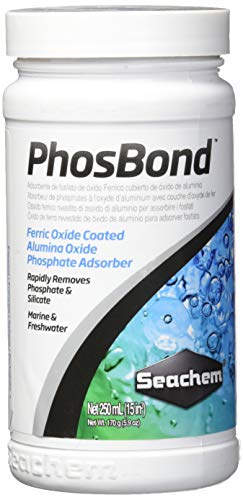
Seachem PhosBond Phosphate Silicate Remover Aquarium Filter Media, 250ml
Last update on 2022-03-24 / Commissions Earned / Images from Amazon Production Advertizing API
Poly-Bio-Marine Poly-Filter – Poly-Filter absorbs nitrate, phosphate and some forms of silica.
Saltwater Only
Reactors – reactors pump h2o into a chamber with chemic filter media that traps phosphates and silicates. Aluminum oxide and granular ferric oxide trap these impurities and aid starve out diatoms.

Two Little Fishies ATLPBR150 GFO PhosBan Reactor 150
Concluding update on 2022-03-24 / Commissions Earned / Images from Amazon Product Advertising API
Pro Tip: Activated carbon does not remove nitrate, phosphate or silica. It tin remove some dissolved organic compounds, merely not the primary culprits that fuel diatom and algae outbreaks.
9. Protein Skimmers
Sad freshwater folks, merely this section is just for the saltwater aquarists.
In actually simple terms, a poly peptide skimmer pumps extremely fine bubbles through water that creates a foam.
Things similar fish waste matter and other nutrients stick to the bubbly foam and go forced up to the elevation of the skimmer where it's collected. Clean h2o sinks and passes back out of the skimmer.
Poly peptide skimmers are bang-up considering they remove wastes before they get the gamble to interruption down and put off nitrate and phosphate.
They can help cutting down on excess nutrients that assist fuel diatoms, blue-green alga and nuisance algae.
Pro Tip: A protein skimmer is highly recommended for any tank over 30 gallons. This will help cut down on the demand for big water changes.
See our guide on protein skimmers hither.
Terminal Word on Brown Algae
Brown algae can be a real hurting. It's not really dangerous, merely it looks awful and makes your tank seem muddied and gross.
Diatom blooms are actually common in newly gear up up aquariums. It'southward a stage that almost every tank has to go through. Luckily, it normally, it clears up on its ain afterward a few months.
If you've got diatoms popping up in your established tank, information technology's an indicator that something is out of residue.
There are lots of strategies and tools that tin help you go things back under control. You can kick that yucky chocolate-brown gunk out of your tank.
And then you can but get back to enjoying your beautiful tank.

Source: https://modestfish.com/brown-algae/
Posted by: hillcamill.blogspot.com
0 Response to "How To Clean Up Brown Hair Algae"
Post a Comment